
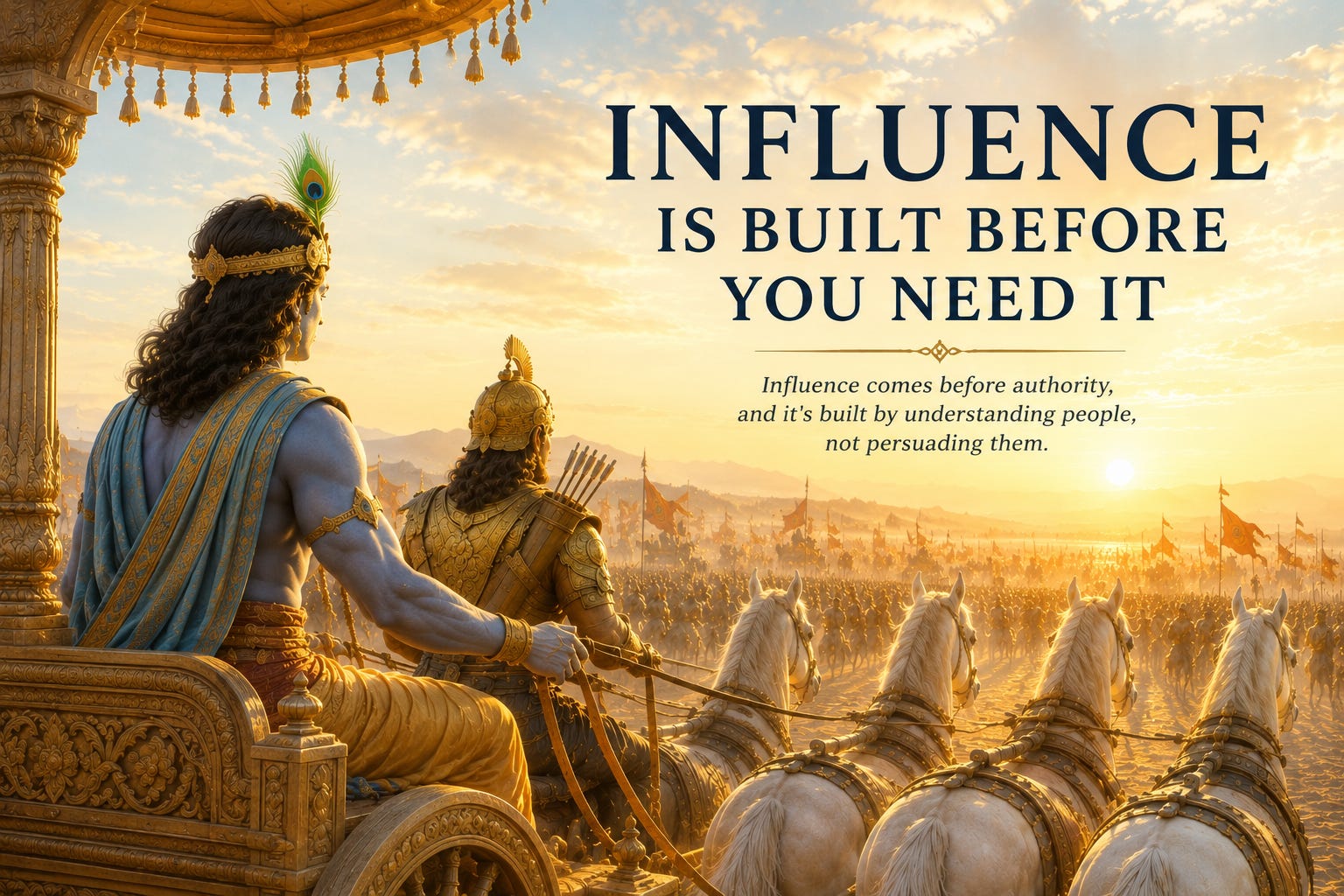
Krishna spends the entire war of Kurukshetra in the humblest job on the field.
He is not a king in this war. He carries no weapon; he has vowed not to fight. His role is sarathi, charioteer. He holds the reins while Arjuna shoots. On paper, he is staff, not line. He has no command, no soldiers of his own in the fight, no formal authority over anyone.
And he may be the most influential figure on the entire field.
Kings defer to him. The outcome of the war bends around his judgment. The most important text in the tradition is a record of him talking to the man whose chariot he was driving. He moved everything, and he did it from a seat with no title.
The principle
We are taught that influence flows from authority: get the title, get the corner office, and then people will listen. It’s backwards. Authority tends to be granted to people who already have influence. The title is the lagging indicator. The influence came first.
And influence is not the same as persuasion. This is the part almost everyone gets wrong. We think being influential means being good at convincing: better arguments, sharper rhetoric, more compelling slides. But the influential don’t skip persuasion. They earn the right to barely need it. Persuasion sits downstream of understanding: they start from “what matters to this person,” not “how do I convince them,” so by the time they make the case, they’re already speaking to what the other side actually wants.
Krishna influenced everyone because he understood everyone: every warrior’s ego, every king’s fear, every fracture in every alliance. He didn’t out-argue people. He knew them.
The translation
Early in my career, at a contact-center company in late 2012, I was a regular engineer with no mandate to change anything. Back then, putting video into a contact center meant serious hardware: dedicated video gateways, multipoint units, specialized endpoints, and the licensing that rode on top. It was a capital decision, not a feature you just turned on.
Our VP of Marketing kept talking up a new thing called WebRTC: real-time video straight in the browser, no plugins, no special hardware. It was barely real yet; the first cross-browser video calls were only just happening. But something about it hooked me. Nobody assigned it to me. I taught myself the technology on my own time and built a rough proof-of-concept: a live call running between two browser tabs, no plugin installed, no hardware behind it. Then I wrote up how it could plug into what we already sold, without the hardware bill.
I didn’t walk into a room and argue for it. I showed people the thing working, framed in the terms each of them cared about: for marketing, the story they were already excited to tell; for engineering, less latency and server load; for leadership, a way to leapfrog a huge hardware investment. By the time I asked to lead the effort, there was almost nothing to persuade. That project became a differentiator in our sales pitches, and the title I’d been nowhere near, Module Leader, followed. The influence came first. The title just caught up.
Look around your organization at the people who move rooms without a title. The engineer whose opinion the VP quietly checks. The person two levels down whose “I’m not sure about this” can stall a launch. They are not louder or more senior. They have built an architecture of influence, and it rests on three things, none of which is a job level:
They understand what people want. Before they make a case, they already know what the other person is trying to protect, win, or avoid. So their “pitch” lands as “here’s how this gets you what you need,” not “here’s why I’m right.”
They are trusted with the truth. Influence compounds on reliability. The person who tells you the uncomfortable thing when it would be easier to flatter you becomes the person you can’t make a decision without.
They give before they ask. Krishna served, literally held the reins, long before the moment his counsel decided the war. Influence is something you deposit before you withdraw.
Notice what these share: each is something you do before you need it. You understand people before you need their support. You tell the truth before you need their trust. You give before you need their help. That is the architecture: influence built in advance.
The person chasing influence through authority says: once I’m promoted, they’ll have to listen. The person building influence says: let me understand you so well that a title becomes a formality. Only one of those compounds.
The practice
Pick one person whose support you’ll need for something that matters in the next few months. Before you ever make your case:
Write down what they actually want: the real thing they’re optimizing for, in their words, not yours. If you’re guessing, you don’t know them well enough yet. Have the conversation whose only goal is to find out.
Do one useful thing for them with no ask attached. Share the context they’re missing, connect them to someone, take a small thing off their plate. Deposit before you withdraw.
When you finally make your case, frame it in their terms. Not “here’s why I’m right.” Instead: “here’s how this gets you what you’re trying to get.”
You’ll notice you barely have to persuade. That’s the point. Persuasion is the tax you pay for not having done this earlier.
The man with no title and no weapon moved the whole war. The influence came before the authority.
Next time: why the real conversation almost never happens in the meeting itself.
This is part 3 of a 10-part series on the inner game of organizational life, drawn from the Mahabharat. Subscribe to get one episode every Thursday, one battle at a time.