
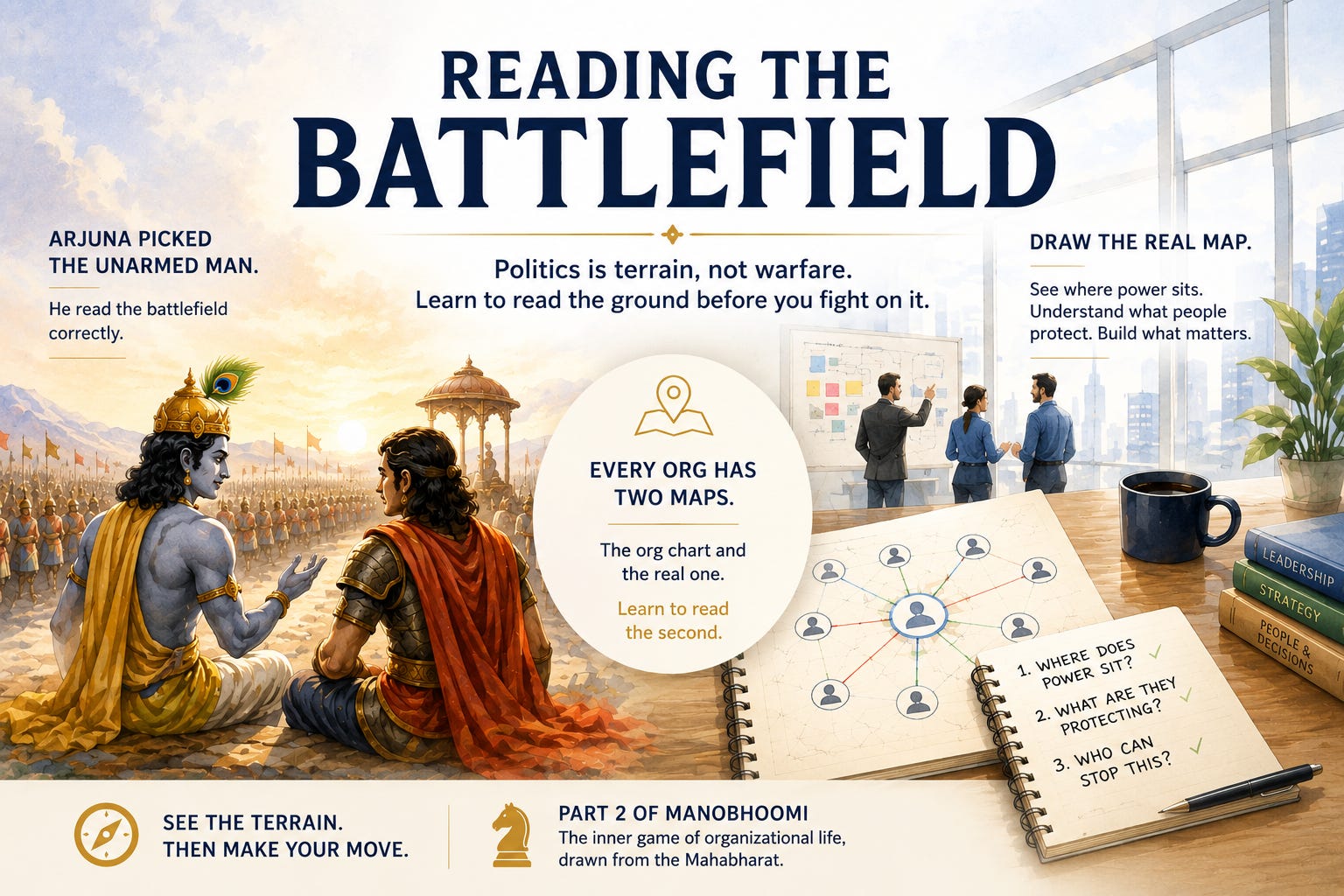
Before the war, both sides go to Krishna. Duryodhana and Arjuna arrive at Krishna’s chamber at nearly the same moment. He is asleep. Duryodhana, proud, takes the seat near Krishna’s head. Arjuna waits humbly at his feet. When Krishna wakes, his eyes fall on Arjuna first, the one at his feet, and he offers each of them a choice: on one side, his entire army, the mighty Narayani Sena. On the other, Krishna himself, alone, who will not lift a single weapon.
Duryodhana can hardly believe his luck. He picks the army. Arjuna picks the unarmed man.
On the surface, Duryodhana had made the shrewder choice. He got the countable thing: thousands of soldiers. Arjuna got one man who had vowed not to fight. But Arjuna had read the battlefield correctly, and Duryodhana had not. He had confused the visible source of power with the actual one.
The principle
Most people treat organizational politics as warfare, a thing you win by fighting harder, pushing more, out-arguing the other side. It isn’t. Politics is terrain. It is the shape of the ground you’re standing on: where the power actually sits, what each person is really trying to protect, and which relationships actually matter when a decision gets made.
You cannot out-fight bad terrain. An army on high ground beats a better army in the valley. And in an organization, the person who has read the terrain will beat the person who simply came prepared to fight. The one who knows that the “decision-maker” defers to someone three doors down, that the loud objection in the meeting is theater and the real veto came by DM an hour earlier.
Duryodhana counted soldiers. Arjuna read the field.
The translation
A few years ago, I pushed to break our main system apart into smaller pieces. When we first entered the market it had been one simple monolith, and that was the right call: it gave us speed, we shipped fast. But two or three years in, the client base had grown and the same design was creaking. Performance was slipping, and the code had turned into a tangle nobody wanted to touch.
I was sure I was right, and I had the data to prove it: the bottlenecks, the graphs, the whole case. I walked into the room expecting the argument to win, because the argument was correct.
It went nowhere. The senior architects and a few of the team looked at my charts, nodded, and quietly did not move. I pushed harder. More data, cleaner slides, the same polite nothing.
What I had misread wasn’t the technology. It was what the people in that room were actually protecting. I thought they were defending the old design. They were defending simplicity: one codebase, one deployment, one place to hold the whole system in your head, and a way of working they had gotten fast at. The new AI coding assistants reinforced that advantage. They could read the whole thing at once and generate code against it easily, and breaking it into services put that simplicity at risk. The decision was never going to be settled by whoever had the best benchmark. It was going to be settled by what those senior people were unwilling to give up.
Once I understood that, I stopped arguing performance. I started answering the thing they actually cared about. I took one small, low-risk piece, the report-generation logic, pulled it out into its own service, and showed it could be built with the same AI tools, deployed on its own, and run without the mess they were bracing for. That one working example did what my benchmarks never could. It didn’t win everyone over, but it earned me enough room to take the same approach to the core logic that mattered most.
I had spent weeks aiming at the wrong target.
Every organization has two maps. There is the org chart, the ranbhoomi as it’s officially drawn, and there is the real map of how things actually get decided. The two are rarely the same. Reading the battlefield means learning the second one.
Ask, before any move:
Where does power actually sit? Titles tell you where authority is supposed to be. Watch instead for whose name gets invoked, whose small objection stops a project, whose approval people seek before they seek the official one.
What is each person actually trying to protect? Not the stated goal. The real one. The manager guarding headcount. The peer whose priorities are threatened by your project. Most people make sense once you know what they’re really trying to hold on to.
Which relationships actually matter? Some people can stop a decision cold. Most can’t, however friendly they seem. Back the wrong one and you’re counting on support that was never really there.
None of this is cynical. It’s just how things actually work. You can insist the org chart is reality all you want. The people making the real decisions won’t notice.
Krishna, unarmed, standing in Arjuna’s chariot, turned out to matter more than an army. Not because he fought, but because he could see the whole field and the people on it, the judgment no number of soldiers can buy. The way I read it, that is why one unarmed man mattered more than Duryodhana’s thousands.
The practice
Draw your organization’s real map on paper. For the decision you care about most right now:
Name the official decision-maker. Then ask: who do they check with before they decide? That person may have more practical influence than the org chart suggests.
For each key player, write one line: “What do they actually need to protect or win here?” If you can’t answer it, you don’t understand the terrain yet, so go find out before you move.
Mark the relationships that can stop this. Who, if they said no, ends it? Those are the ones that matter. The rest is noise.
Keep it private. Redraw it every quarter, because terrain shifts. But once you can see the real map, you’ll stop fighting uphill by accident.
Next week: The Architecture of Influence. How the unarmed man in the chariot became the most powerful figure in the war.
This is part 2 of a 10-part series on the inner game of organizational life, drawn from the Mahabharat. Subscribe to get one episode every Thursday, one battle at a time.